It Is Good and Holy to Think of the Dead Rising Again

Plaque depicting saints ascension from the dead
Resurrection or anastasis is the concept of coming back to life after death. In a number of religions, a dying-and-rising god is a deity which dies and resurrects. Reincarnation is a similar procedure hypothesized by other religions, which involves the aforementioned person or deity coming dorsum to live in a dissimilar torso, rather than the aforementioned one.
The resurrection of the dead is a standard eschatological conventionalities in the Abrahamic religions. Equally a religious concept, information technology is used in 2 singled-out respects: a belief in the resurrection of individual souls that is current and ongoing (Christian idealism, realized eschatology), or else a belief in a singular resurrection of the dead at the terminate of the world. Some believe the soul is the actual vehicle by which people are resurrected.[one]
The death and resurrection of Jesus is a cardinal focus of Christianity. Christian theological debate ensues with regard to what kind of resurrection is factual – either a spiritual resurrection with a spirit body into Heaven, or a textile resurrection with a restored human trunk.[2] While almost Christians believe Jesus' resurrection from the dead and ascension to Heaven was in a material body, some believe it was spiritual.[3] [4] [five]
Etymology [edit]
Resurrection, from the Latin noun resurrectio -onis, from the verb rego, "to make straight, rule" + preposition sub, "nether", contradistinct to subrigo and contracted to surgo, surrexi, surrectum ("to ascension", "go up", "stand up"[6]) + preposition re-, "again",[7] thus literally "a straightening from nether once again".
Organized religion [edit]
Ancient religions in the Virtually East [edit]
The concept of resurrection is found in the writings of some aboriginal non-Abrahamic religions in the Middle East. A few extant Egyptian and Canaanite writings insinuate to dying and rising gods such as Osiris and Baal. Sir James Frazer in his book The Golden Bough relates to these dying and rising gods,[8] but many of his examples, according to various scholars, distort the sources.[ix] Taking a more positive position, Tryggve Mettinger argues in his contempo book that the category of rise and return to life is significant for Ugaritic Baal, Melqart, Adonis, Eshmun, Osiris and Dumuzi.[10]
Ancient Greek religion [edit]
In ancient Greek organized religion a number of men and women became physically immortal as they were resurrected from the dead. Asclepius was killed by Zeus, simply to be resurrected and transformed into a major deity. Achilles, subsequently being killed, was snatched from his funeral pyre by his divine female parent Thetis and resurrected, brought to an immortal existence in either Leuce, the Elysian plains or the Islands of the Blest. Memnon, who was killed by Achilles, seems to take received a similar fate. Alcmene, Castor, Heracles, and Melicertes, were likewise among the figures sometimes considered to take been resurrected to physical immortality. According to Herodotus'south Histories, the seventh century BC sage Aristeas of Proconnesus was first institute dead, after which his torso disappeared from a locked room. Later he institute not only to accept been resurrected just to have gained immortality.[xi]
Many other figures, like a great part of those who fought in the Trojan and Theban wars, Menelaus, and the historical pugilist Cleomedes of Astupalaea, were also believed to take been made physically immortal, merely without having died in the commencement place. Indeed, in Greek organized religion, immortality originally always included an eternal spousal relationship of body and soul.[12] As may be witnessed even into the Christian era, not least by the complaints of various philosophers over popular beliefs, traditional Greek believers maintained the confidence that sure individuals were resurrected from the dead and made physically immortal and that for the residuum of us, we could only look forward to an existence as disembodied and dead souls.[13]
Greek philosophers generally denied this traditional religious belief in concrete immortality. Writing his Lives of Illustrious Men (Parallel Lives) in the first century, the Middle Platonic philosopher Plutarch in his chapter on Romulus gave an account of the mysterious disappearance and subsequent deification of this first rex of Rome, comparing it to traditional Greek beliefs such equally the resurrection and concrete immortalization of Alcmene and Aristeas the Proconnesian, "for they say Aristeas died in a fuller'south piece of work-shop, and his friends coming to look for him, institute his trunk vanished; and that some presently after, coming from abroad, said they met him traveling towards Croton". Plutarch openly scorned such beliefs held in traditional aboriginal Greek religion, writing, "many such improbabilities practise your fabulous writers relate, deifying creatures naturally mortal."
Alcestis undergoes resurrection over a three-day period of fourth dimension,[fourteen] but without achieving immortality.[15]
The parallel between these traditional beliefs and the subsequently resurrection of Jesus was not lost on the early on Christians, every bit Justin Martyr argued: "when we say ... Jesus Christ, our teacher, was crucified and died, and rose again, and ascended into heaven, nosotros propose aught different from what you believe regarding those whom you consider sons of Zeus." (1 Apol. 21).
Buddhism [edit]
There are stories in Buddhism where the power of resurrection was allegedly demonstrated in Chan or Zen tradition. One is the legend of Bodhidharma[ citation needed ], the Indian primary who brought the Ekayana school of India that later became Chan Buddhism to Mainland china.
The other is the passing of Chinese Chan primary Puhua (Japanese:Jinshu Fuke) and is recounted in the Record of Linji (Japanese: Rinzai Gigen). Puhua was known for his unusual behavior and teaching style so information technology is no wonder that he is associated with an event that breaks the usual prohibition on displaying such powers. Hither is the account from Irmgard Schloegl'due south "The Zen Education of Rinzai".
"One 24-hour interval at the street market Fuke was begging all and sundry to give him a robe. Everybody offered him ane, only he did non want whatsoever of them. The master [Linji] fabricated the superior buy a coffin, and when Fuke returned, said to him: "There, I had this robe made for you lot." Fuke shouldered the bury, and went back to the street market, calling loudly: "Rinzai had this robe made for me! I am off to the East Gate to enter transformation" (to die)." The people of the market place crowded later on him, eager to look. Fuke said: "No, not today. Tomorrow, I shall get to the South Gate to enter transformation." And so for iii days. Nobody believed it any longer. On the 4th day, and now without whatsoever spectators, Fuke went alone exterior the urban center walls, and laid himself into the coffin. He asked a traveler who chanced by to nail downwards the chapeau.
The news spread at once, and the people of the market rushed at that place. On opening the bury, they establish that the body had vanished, but from loftier up in the sky they heard the ring of his hand bong."[16]
Christianity [edit]
In Christianity, resurrection well-nigh critically concerns the resurrection of Jesus, simply likewise includes the resurrection of Judgment Day known every bit the resurrection of the dead by those Christians who subscribe to the Nicene Creed (which is the majority or mainstream Christianity), as well as the resurrection miracles done past Jesus and the prophets of the Old Testament.
Resurrection miracles [edit]

The Resurrection of Lazarus, painting by Leon Bonnat, France, 1857.
In the New Testament, Jesus is said to accept raised several persons from death. These resurrections included the daughter of Jairus shortly after expiry, a boyfriend in the midst of his own funeral procession, and Lazarus of Bethany, who had been buried for four days.
During the Ministry building of Jesus on globe, earlier his death, Jesus commissioned his Twelve Apostles to, among other things, raise the dead.[17]
Similar resurrections are credited to the apostles and Catholic saints. In the Acts of the Apostles, Saint Peter raised a woman named Dorcas (too called Tabitha), and Paul the Apostle revived a man named Eutychus who had fallen comatose and fell from a window to his death. According to the Gospel of Matthew, after Jesus'southward resurrection, many of those previously dead came out of their tombs and entered Jerusalem, where they appeared to many. Following the Apostolic Age, many saints were said to resurrect the expressionless, as recorded in Orthodox Christian hagiographies.[ citation needed ] St Columba supposedly raised a boy from the dead in the land of Picts.[18]
Resurrection of Jesus [edit]
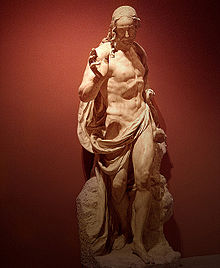
Christians regard the resurrection of Jesus as the cardinal doctrine in Christianity. Others take the incarnation of Jesus to be more central; however, it is the miracles – and peculiarly his resurrection – which provide validation of his incarnation. According to Paul, the entire Christian faith hinges upon the centrality of the resurrection of Jesus and the hope for a life after decease. The Apostle Paul wrote in his offset letter to the Corinthians:
If only for this life we have hope in Christ, we are to be pitied more than all men. But Christ has indeed been raised from the expressionless, the kickoff fruits of those who accept fallen comatose.[19]
Resurrection of the dead [edit]
Christianity started as a religious movement within 1st-century Judaism (late 2nd Temple Judaism), and it retains what the New Testament itself claims was the Pharisaic belief in the afterlife and resurrection of the expressionless. Whereas this belief was but one of many beliefs held nigh the world to come in Second Temple Judaism, and was notably rejected by the Sadducees, merely accepted by the Pharisees (cf. Acts 23:6-8). Belief in the resurrection became dominant within Early Christianity and already in the Gospels of Luke and John included an insistence on the resurrection of the flesh. Almost modern Christian churches continue to uphold the belief that at that place will be a final resurrection of the dead and earth to come.
Belief in the resurrection of the dead, and Jesus' role every bit approximate, is codified in the Apostles' Creed, which is the fundamental creed of Christian baptismal faith. The Volume of Revelation also makes many references about the Day of Judgment when the dead will be raised.
The accent on the literal resurrection of the mankind remained strong in the medieval ages, and even so remains so in Orthodox churches.[xx] In modernistic Western Christianity, specially "from the 17th to the 19th century, the language of popular piety no longer evoked the resurrection of the soul but everlasting life. Although theological textbooks still mentioned resurrection, they dealt with information technology as a speculative question more than as an existential problem."[21]
Difference from Ideal philosophy [edit]
In Platonic philosophy and other Greek philosophical thought, at death the soul was said to leave the inferior body behind. The thought that Jesus was resurrected spiritually rather than physically even gained popularity amongst some Christian teachers, whom the author of ane John declared to be antichrists. Similar beliefs appeared in the early on church as Gnosticism. However, in Luke 24:39, the resurrected Jesus expressly states "behold my easily and my feet, that information technology is I myself. Handle me and see, for a spirit does not have flesh and basic as you see I have."
Hinduism [edit]
There are folklore, stories, and extractions from sure holy texts that refer to resurrections. Ane major sociology is that of Savitri saving her husband'due south life from Yamraj. In the Ramayana, after Ravana was slain by Rama in a great battle between good and evil, Rama requests the king of Gods, Indra, to restore the lives of all the monkeys who died in the nifty battle. Mahavatar Babaji and Lahiri Mahasaya are too believed to take resurrected themselves.
Islam [edit]
Belief in the Twenty-four hour period of Resurrection (yawm al-qiyāmah) is too crucial for Muslims. They believe the time of Qiyāmah is preordained by God but unknown to man. The trials and tribulations preceding and during the Qiyāmah are described in the Quran and the hadith, and also in the commentaries of scholars. The Quran emphasizes bodily resurrection, a break from the pre-Islamic Arabian understanding of death.[22]
According to Nasir Khusraw (d. after 1070), an Ismaili thinker of the Fatimid era, the Resurrection (Qiyāma) will exist ushered by the Lord of the Resurrection (Qāʾim al-Qiyāma), an individual symbolizing the purpose and pinnacle of creation from among the progeny of Muhammad and his Imams. Through this individual, the world will come out of darkness and ignorance and "into the light of her Lord" (Quran 39:69). His era, unlike that of the enunciators of the divine revelation (nāṭiqs) before him, is non one where God prescribes the people to work but instead one where God rewards them. Preceding the Lord of the Resurrection (Qāʾim) is his proof (ḥujjat). The Qur'anic verse stating that "the night of ability (laylat al-qadr) is better than a thousand months" (Quran 97:3) is said to refer to this proof, whose knowledge is superior to that of a thousand Imams, though their rank, collectively, is one. Hakim Nasir besides recognizes the successors of the Lord of the Resurrection to exist his deputies (khulafāʾ).[23]
Judaism [edit]
There are three explicit examples in the Hebrew Bible of people existence resurrected from the dead:
- The prophet Elijah prays and God raises a immature boy from death (1 Kings 17:17-24)
- Elisha raises the son of the Woman of Shunem (2 Kings 4:32-37) whose birth he previously foretold (2 Kings iv:8-16)
- A dead human'southward trunk that was thrown into the expressionless Elisha's tomb is resurrected when the trunk touches Elisha's bones (2 Kings xiii:21)
Co-ordinate to Herbert C. Brichto, writing in Reform Judaism'south Hebrew Matrimony Higher Annual, the family unit tomb is the central concept in understanding biblical views of the afterlife. Brichto states that information technology is "non mere sentimental respect for the physical remains that is...the motivation for the practice, merely rather an causeless connection betwixt proper sepulture and the status of happiness of the deceased in the afterlife".[24]
Co-ordinate to Brichto, the early on Israelites apparently believed that the graves of family, or tribe, united into one, and that this unified collectivity is to what the Biblical Hebrew term Sheol refers, the common grave of humans. Although not well defined in the Tanakh, Sheol in this view was a subterranean underworld where the souls of the dead went subsequently the body died. The Babylonians had a similar underworld called Aralu, and the aboriginal Greeks had one known every bit Hades. Co-ordinate to Brichto, other biblical names for Sheol were Abaddon "ruin", constitute in Psalm 88:xi, Task 28:22 and Proverbs 15:11; Bor "pit", found in Isaiah 14:xv, 24:22, Ezekiel 26:20; and Shakhat "abuse", found in Isaiah 38:17, Ezekiel 28:viii.[25]
During the Second Temple menstruation, there developed a diversity of beliefs concerning the resurrection.[26] The concept of resurrection of the physical body is found in ii Maccabees, co-ordinate to which it will happen through re-creation of the flesh.[27] Resurrection of the dead besides appears in item in the extra-canonical Book of Enoch,[28] two Baruch,[29] and 2 Esdras. According to the British scholar in aboriginal Judaism Philip R. Davies, there is "picayune or no articulate reference … either to immortality or to resurrection from the dead" in the texts of the Dead Bounding main Scrolls.[30] C.D. Elledge, yet, argues that some form of resurrection may be referred to in the Dead Sea texts 4Q521, Pseudo-Ezekiel, and 4QInstruction.[31]
Both Josephus and the New Testament record that the Sadducees did not believe in an afterlife,[32] but the sources vary on the beliefs of the Pharisees. The New Testament claims that the Pharisees believed in the resurrection, but does not specify whether this included the flesh or not.[33] According to Josephus, who himself was a Pharisee, the Pharisees held that simply the soul was immortal and the souls of good people volition "pass into other bodies," while "the souls of the wicked will suffer eternal punishment."[34] Paul the Apostle, who too was a Pharisee,[35] said that at the resurrection what is "sown every bit a natural torso is raised a spiritual body."[36] The Volume of Jubilees seems to refer to the resurrection of the soul merely, or to a more general idea of an immortal soul.[37]
Anastasis in contemporary philosophy [edit]
Anastasis or Ana-stasis is a concept in contemporary philosophy emerging from the works of Jean-Luc Nancy, Divya Dwivedi and Shaj Mohan.[38] Nancy adult the concept through his interpretation of paintings depicting the resurrection of Jesus Christ.[39] Dwivedi and Mohan, referring to Nancy, divers Ana-stasis as coming over stasis, which is a method for philosophy to overcome its end every bit Martin Heidegger defined. This concept is noted to be linked in the works of Nancy, Dwivedi and Mohan to have a relation to Heidegger's "other starting time of philosophy".[twoscore] The use of the phrase "anastasis of philosophy" indicates such other beginning.[41]
Technological resurrection [edit]
Cryonics is the low-temperature freezing (usually at −196 °C or −320.8 °F or 77.1 K) of a homo corpse or severed head, with the speculative hope that resurrection may be possible in the futurity.[42] [43] Cryonics is regarded with skepticism within the mainstream scientic community. It is generally viewed as a pseudoscience,[44] and has been characterized as quackery.[45]
Russian cosmist Nikolai Fyodorovich Fyodorov advocated resurrection of the dead using scientific methods. Fedorov tried to programme specific actions for scientific inquiry of the possibility of restoring life and making it infinite. His first project is connected with collecting and synthesizing decayed remains of dead based on "knowledge and command over all atoms and molecules of the earth". The 2d method described by Fedorov is genetic-hereditary. The revival could exist done successively in the ancestral line: sons and daughters restore their fathers and mothers, they in turn restore their parents and and then on. This means restoring the ancestors using the hereditary information that they passed on to their children. Using this genetic method it is only possible to create a genetic twin of the dead person. It is necessary to give back the revived person his old listen, his personality. Fedorov speculates about the idea of "radial images" that may comprise the personalities of the people and survive after death. However, Fedorov noted that even if a soul is destroyed later death, Homo volition learn to restore information technology whole by mastering the forces of decay and fragmentation.[46]
In his 1994 volume The Physics of Immortality, American physicist Frank J. Tipler, an expert on the full general theory of relativity, presented his Omega Point Theory which outlines how a resurrection of the expressionless could accept place at the end of the creation. He posits that humans will evolve into robots which will plough the entire cosmos into a supercomputer which will, shortly earlier the Big Crisis, perform the resurrection within its net, reconstructing formerly dead humans (from data captured by the supercomputer from the past light cone of the cosmos) as avatars within its metaverse.[47]
David Deutsch, British physicist and pioneer in the field of quantum computing, agrees with Tipler'due south Omega Signal cosmology and the idea of resurrecting deceased people with the assistance of quantum computers[48] but he is critical of Tipler's theological views.
Italian physicist and computer scientist Giulio Prisco presents the thought of "quantum archeology", "reconstructing the life, thoughts, memories, and feelings of any person in the past, up to any desired level of detail, and thus resurrecting the original person via 'copying to the future'".[49]
In his book Mind Children, roboticist Hans Moravec proposed that a future supercomputer might be able to resurrect long-dead minds from the information that however survived. For example, this information tin exist in the form of memories, filmstrips, medical records, and DNA.[50] [51]
Ray Kurzweil, American inventor and futurist, believes that when his concept of singularity comes to pass, it will exist possible to resurrect the dead by digital recreation.[52]
In their science fiction novel The Light of Other Days, Sir Arthur Clarke and Stephen Baxter imagine a hereafter civilization resurrecting the dead of by ages past reaching into the past, through micro wormholes and with nanorobots, to download full snapshots of brain states and memories.[53]
Both the Church of Perpetual Life and the Terasem Movement consider themselves transreligions and advocate for the utilise of engineering science to indefinitely extend the human lifespan.[54]
Zombies [edit]
A zombie (Haitian French: zombi , Haitian Creole: zonbi) is a fictional undead being created through the downtime of a man corpse. Zombies are most unremarkably found in horror and fantasy genre works. The term comes from Haitian folklore, where a zombie is a dead torso reanimated through various methods, most commonly magic.
Disappearances (every bit distinct from resurrection) [edit]
As knowledge of different religions has grown, so have claims of bodily disappearance of some religious and mythological figures. In ancient Greek religion, this was a way the gods made some physically immortal, including such figures as Cleitus, Ganymede, Menelaus, and Tithonus.[55] After his decease, Cycnus was changed into a swan and vanished. In his chapter on Romulus from Parallel Lives, Plutarch criticises the continuous belief in such disappearances, referring to the allegedly miraculous disappearance of the historical figures Romulus, Cleomedes of Astypalaea, and Croesus. In ancient times, Greek and Roman pagan similarities were explained by the early Christian writers, such as Justin Martyr, as the work of demons, with the intention of leading Christians astray.[56]
In the Buddhist Ballsy of King Gesar, also spelled every bit Geser or Kesar, at the end, chants on a mount top and his clothes autumn empty to the footing.[57] The body of the first Guru of the Sikhs, Guru Nanak Dev, is said to have disappeared and flowers left in place of his expressionless body.[58]
Lord Raglan's Hero Pattern lists many religious figures whose bodies disappear, or have more than than one sepulchre.[59] B. Traven, author of The Treasure of the Sierra Madre, wrote that the Inca Virococha arrived at Cusco (in modern-day Republic of peru) and the Pacific seacoast where he walked across the water and vanished.[threescore] It has been thought that teachings regarding the purity and incorruptibility of the hero's human being torso are linked to this phenomenon. Perhaps, this is also to deter the practice of disturbing and collecting the hero's remains. They are safely protected if they take disappeared.[61]
The outset such case mentioned in the Bible is that of Enoch (son of Jared, great-grandfather of Noah, and father of Methuselah). Enoch is said to have lived a life where he "walked with God", after which "he was not, for God took him" (Genesis v:1–18).[62] In Deuteronomy (34:6) Moses is secretly buried. Elijah vanishes in a whirlwind two Kings (2:xi). In the Synoptic Gospels, afterward hundreds of years these two earlier Biblical heroes suddenly reappear, and are reportedly seen walking with Jesus, then over again vanish.[63] In the Gospel of Luke, the last time Jesus is seen (24:51) he leaves his disciples by ascending into the sky. This ascent of Jesus was a "disappearance" of sorts as recorded by Luke but was after the concrete resurrection occurring several days earlier.
Meet besides [edit]
- 1 Corinthians fifteen
- Information-theoretic expiry
- Metempsychosis
- Near expiry feel
- Necromancy
- Riverworld
- Suspended animation
- Undead
References [edit]
- ^ "Gregory of Nyssa: "On the Soul and the Resurrection:" Notwithstanding far from each other their natural propensity and their inherent forces of repulsion urge them, and debar each from mingling with its reverse, none the less will the soul exist nigh each by its power of recognition, and volition persistently cling to the familiar atoms, until their concourse after this division over again takes identify in the same way, for that fresh formation of the dissolved body which volition properly be, and exist called, resurrection". Ccel.org.
- ^ Every bit in the Apostles' Creed: "I believe in the Holy Spirit, the holy catholic Church building, the communion of saints, the forgiveness of sins, the resurrection of the body, and life everlasting." Cosmic Encyclopedia: Full general Resurrection: "Resurrection is the ascent again from the expressionless, the resumption of life. The Fourth Lateran Council (1215) teaches that all men, whether elect or reprobate, "will ascension once more with their own bodies which they now comport almost with them" (chapter "Firmiter"). In the linguistic communication of the creeds and professions of faith this return to life is called resurrection of the body (resurrectio carnis, resurrectio mortuoram, anastasis ton nekron) for a double reason: start, since the soul cannot die, it cannot be said to render to life; second the heretical contention of Hymeneus and Philitus that the Scriptures denote by resurrection not the return to life of the body, just the rising of the soul from the death of sin to the life of grace, must be excluded."
- ^ Symes, R. C. "According to Paul of Tarsus, the resurrection transformed Jesus into the Christ, the Son of God and Savior of the world. Christ's resurrected body was not a resuscitated concrete trunk, but a new body of a spiritual/angelic nature: the natural body comes commencement and then the spiritual trunk (1 Cor. 15:46). Paul never says that the earthly body becomes immortal". religioustolerance.org.
- ^ The Watchtower Society claims that Jesus was not raised in His actual concrete human body, but rather was raised equally an invisible spirit being—what He was before, the archangel Michael. They believe that Christ's post-Resurrection appearances on globe were on-the-spot manifestations and materializations of mankind and basic, with different forms, that the Apostles did not immediately recognize. Their explanation for the statement "a spirit hath not flesh and bones" is that Christ was saying that he was not a ghostly apparition, but a true materialization in flesh, to be seen and touched, every bit proof that he was actually raised. But that, in fact, the risen Christ was, in actuality, a divine spirit existence, who made himself visible and invisible at will. The Christian Congregation of Jehovah'southward Witnesses believes that Christ'south perfect manhood was forever sacrificed at Calvary, and that it was not actually taken back. They country: "...in his resurrection he 'became a life-giving spirit.' That was why for most of the time he was invisible to his faithful apostles... He needs no human body any longer... The homo trunk of flesh, which Jesus Christ laid down forever as a bribe sacrifice, was disposed of by God'southward power."—Things in Which it is Incommunicable for God to Lie, pages 332, 354.
- ^ "Resurrection Theories". Gospel-mysteries.net. Retrieved 2013-05-04 .
- ^ Karl Ernst Georges, Ferruccio Badellino, Oreste Calonghi, Dizionario Latino-Italiano (Latin to Italian dictionary), Rosenberg & Sellier, 3rd edition, Turin, 1989, 2.957 pages
- ^ Cassell's Latin Lexicon
- ^ Sir James Frazer (1922). The Golden Bough: A Study in Magic and Religion Ware: Wordsworth 1993.
- ^ Jonathan Z. Smith "Dying and Rising Gods" in Mircea Eliade (ed.) The Encyclopedia of Religion: Vol. 3. New York: Simon & Schuster Macmillan 1995: 521-27.
- ^ Mettinger, Riddle of Resurrection, 55-222.
- ^ Endsjø, Greek Resurrection Beliefs, 54-64; cf. Finney, Resurrection, Hell and the Afterlife, 13-xx.
- ^ Endsjø, Greek Resurrection Beliefs, 21-45, 64-72.
- ^ Rohde, Psyche, 335-489.
- ^ Euripides (2003). Luschnig, C. A. Due east. (ed.). Euripides' Alcestis. Oklahoma serial in classical culture. Vol. 29. Norman, Oklahoma: Academy of Oklahoma Press. p. 219. ISBN9780806135748 . Retrieved 2019-eleven-04 .
[...] Alcestis' resurrection and restoration to her home [...] once the three days pass that information technology will take for Alcestis to be cleansed of her obligations to the Netherworld [...]
- ^ Transactions of the American Philological Association. Scholars Printing. 124. 1994. ISSN 1533-0699 https://books.google.com/books?id=GAQ8AAAAMAAJ. Retrieved 2019-11-04 .
And it should be remembered that Alcestis is not immortal — she and Admetus must eventually die their fated deaths.
- ^ Schloegl, Irmgard; tr. "The Zen Teaching of Rinzai". Shambhala Publications, Inc., Berkeley, 1976. Page 76. ISBN 0-87773-087-iii.
- ^ Not in the Great Committee of the resurrected Jesus, but only in the so-called Bottom Commission of Matthew, specifically Matthew x:8.
- ^ Adomnan of Iona. Life of St Columba. Penguin books, 1995
- ^ 1 Corinthians 15:19-xx
- ^ Bynum Resurrection of the body 1996.
- ^ Encyclopedia of Christian Theology Vol. iii, "Resurrection of the Dead" by André Dartigues, ed. by Jean-Yves Lacoste (New York: Routledge, 2005), 1381.
- ^ See:
- "Resurrection", The New Encyclopedia of Islam (2003)
- "Avicenna". Encyclopaedia of Islam Online. : Ibn Sīnā, Abū ʿAlī al-Ḥusayn b. ʿAbd Allāh b. Sīnā is known in the W as "Avicenna".
- 50. Gardet. "Qiyama". Encyclopaedia of Islam Online.
- ^ Virani, Shafique (January 2005). "The Days of Creation in the Thought of Nasir Khusraw". Nasir Khusraw: Yesterday, Today, Tomorrow.
- ^ Raphael Jewish Views of the Afterlife, 45.
- ^ Herbert Chanon Brichto "Kin, Cult, State and Afterlife – A Biblical Complex", Hebrew Wedlock College Annual 44, p.8 (1973)
- ^ Cf. Elledge Resurrection of the Expressionless in Early Judaism, nineteen-65; Finney Resurrection, Hell and the Afterlife, 49-77; Lehtipuu Debates over the Resurrection, 31-40.
- ^ two Maccabees 7.11, vii.28.
- ^ 1 Enoch 61.5, 61.2.
- ^ 2 Baruch 50.2, 51.5
- ^ Philip R. Davies. "Decease, Resurrection and Life Afterward Death in the Qumran Scrolls" in Avery-Peck & Neusner (eds.) Judaism in Late Antiquity, 209; cf. Nickelsburg Resurrection, Immortality, and Eternal Life, 179.
- ^ Elledge Resurrection of the Dead in Early Judaism, 160-72.
- ^ Josephus Antiquities eighteen.16; Matthew 22.23; Mark 12.18; Luke 20.27; Acta 23.8.
- ^ Acta 23.8.
- ^ Josephus Jewish War ii.viii.14; cf. Antiquities viii.14-15.
- ^ Acts 23.six, 26.5.
- ^ 1 Corinthians 15.35-53
- ^ Jubilees 23.31
- ^ "Jean-Luc Nancy : Anastasis de la pensée - Traversées". Centre Pompidou (in French). Retrieved 2022-02-01 .
- ^ Nancy, Jean-Luc (25 August 2009). Noli Me Tangere: On the Raising of the Body. Translated by Brault, Pascale-Anne; Naas, Michael; Clift, Sarah. ISBN9780823228898.
- ^ Janardhanan, Reghu. "The Deconstructive Materialism of Dwivedi and Mohan: A New Philosophy of Freedom". positions politics.
- ^ "The anastasis of philosophy". Iranian Labour News Bureau. 2021-11-16.
- ^ McKie, Robin (13 July 2002). "Cold facts about cryonics". The Observer . Retrieved 1 Dec 2013.
Cryonics, which began in the Sixties, is the freezing – usually in liquid nitrogen – of human beings who have been legally declared dead. The aim of this process is to keep such individuals in a state of refrigerated limbo and so that it may get possible in the future to resuscitate them, cure them of the condition that killed them, and and so restore them to functioning life in an era when medical science has triumphed over the activities of the Grim Reaper.
- ^ "Dying is the terminal affair anyone wants to practice – so continue absurd and carry on". The Guardian. 10 October 2015. Retrieved 21 Feb 2016.
- ^ Steinbeck RL (29 September 2002). "Mainstream science is frosty over keeping the expressionless on ice". Chicago Tribune.
- ^ Hoppe, Nils (2016-11-18). "Justice Cryogenically Delayed is Justice Denied?". BMJ Journal of Medical Ethics blog . Retrieved 2019-06-24 .
The mere fact that we experience the promises fabricated by the cryopreservation industry amount to a near grievous form of quackery ...
; Zimmer, Carl; Hamilton, David (October 2007). "Could He Live to 2150?". Best Life.Quack watch: The post-obit controversial treatments are all being touted every bit antiaging miracle cures.
; Harold Schechter (two June 2009). The Whole Decease Catalog: A Lively Guide to the Bitter End. Random House Publishing Group. p. 206. ISBN978-0-345-51251-2. ; Pein, Corey (2016-03-08). "Everybody Freeze!". The Baffler . Retrieved 2019-06-24 . ; Chiasson, Dan (Dec 2014). "Heads Will Roll". Harper's Magazine. ISSN 0017-789X. Retrieved 2019-06-24 . ; Miller, Laura (2012-06-24). ""The Mansion of Happiness": Matters of life and death". Salon . Retrieved 2019-06-24 . ; Almond, Steve (2014-02-28). "Sparks of Life". The New York Times. ISSN 0362-4331. Retrieved 2019-06-24 . ; Carroll, Robert Todd (2003). The Skeptics Dictionary: A Collection of Strange Beliefs, Amusing Deceptions, and Unsafe Delusions. Wiley. ISBN0471272426.A business based on footling more than hope for developments that can be imagined past scientific discipline is quackery. There is little reason to believe that the promises of cryonics will always be fulfilled.
- ^ Nikolai Berdyaev, The Faith of Resusciative Resurrection. "The Philosophy of the Common Task of N. F. Fedorov.
- ^ Tipler The Physics of Immortality. 56-page excerpt available hither.
- ^ David Deutsch (1997). "The Ends of the Universe". The Fabric of Reality: The Science of Parallel Universes—and Its Implications. London: Penguin Press. ISBN 0-7139-9061-nine.
- ^ Giulio Prisco (October 11, 2015). "Technological Resurrection Concepts From Fedorov to Quantum Archeology". Institute for Ideals and Emerging Technologies. Retrieved December ten, 2015. Giulio Prisco (Dec 16, 2011). "Quantum Archæology". Retrieved half dozen July 2015.
- ^ Moravec, Hans (1988). Mind Children . Harvard University Press. ISBN9780674576186 . Retrieved half dozen July 2015.
- ^ "Resurrecting the Dead - Futurisms - The New Atlantis". Futurisms - The New Atlantis . Retrieved half-dozen July 2015.
- ^ Socrates (18 July 2012). "Ray Kurzweil on the Singularity and Bringing Back the Dead". Singularity Blog . Retrieved half-dozen July 2015.
- ^ Arthur C. Clarke, Profiles of the Future: An Enquiry into the Limits of the Possible, Millennium [i.due east., Second] Edition, Victor Gollancz – An imprint of Orion Books Ltd., 1999, p. 118: "the novel that Stephen Baxter has at present written from my synopsis — The Low-cal of Other Days."
- ^ Anthony Cuthbertson (December ix, 2015). "Virtual reality heaven: How technology is redefining decease and the afterlife". International Business organization Times . Retrieved December 10, 2015.
- ^ Rohde Psyche, 55-87; Endsjø Greek Resurrection Beliefs, 64-72.
- ^ Justin Martyr, Dialogue with Trypho.
- ^ Alexandra David-Neel, and Lama Yongden, The Superhuman Life of Gesar of Ling, Passenger, 1933, While still in oral tradition, it is recorded for the first time by an early European traveler.
- ^ Shukla, A. (2019). The Politics of Kartarpur Corridor and Bharat-Islamic republic of pakistan Relations. Indian Council of World Diplomacy, ten, 1-eight.
- ^ Otto Rank, Lord Raglan, and Alan Dundes, In Quest of the Hero, Princeton University Printing, 1990
- ^ B. Traven, The Creation of the Sun and Moon, Lawerence Hill Books, 1977
- ^ Run across: Michael Paterniti, Driving Mr. Albert: A Trip Beyond America with Einstein'southward Brain, The Dial Press, 2000
- ^ Genesis 5:18–24
- ^ Mark (9:2–8), Matthew (17:1–8) and Luke (9:28–33)
Further reading [edit]
- Alan J. Avery-Peck & Jacob Neusner (eds.). Judaism in Late Antiquity: Office Four: Decease, Life-After-Decease, Resurrection, and the Globe-To-Come up in the Judaisms of Antiquity. Leiden: Brill, 2000.
- Caroline Walker Bynum. The Resurrection of the Body in Western Christianity, 200-1336. New York: Columbia University Printing, 1996.
- C.D. Elledge. Resurrection of the Dead in Early Judaism, 200 BCE -- CE 200. Oxford: Oxford Academy Press, 2017.
- Dag Øistein Endsjø. Greek Resurrection Beliefs and the Success of Christianity. New York: Palgrave Macmillan, 2009.
- Marker T. Finney. Resurrection, Hell and the Afterlife: Torso and Soul in Artifact, Judaism and Early on Christianity. New York: Routledge, 2017.
- Nikolai Fyodorovich Fyodorov. Philosophy of Physical Resurrection 1906.
- Edwin Hatch. Influence of Greek Ideas and Usages Upon the Christian Church (1888 Hibbert Lectures).
- Alfred J Hebert. Raised from the Expressionless: Truthful Stories of 400 Resurrection Miracles.
- Dierk Lange. "The dying and the rise God in the New Year Festival of Ife", in: Lange, Ancient Kingdoms of Due west Africa, Dettelbach: Röll Vlg. 2004, pp. 343–376.
- Outi Lehtipuu. Debates over the Resurrection of the Expressionless: Constructing Early Christian Identity. Oxford: Oxford Academy Press, 2015.
- Richard Longenecker, editor. Life in the Face of Death: The Resurrection Message of the New Testament. 1000 Rapids: Eerdmans, 1998.
- Joseph McCabe. Myth of the Resurrection and Other Essays, Prometheus books: New York, 1993 [1925]
- Kevin J. Madigan & Jon D. Levenson. Resurrection: The Power of God for Christians and Jews. New Haven: Yale Academy Press, 2008.
- Tryggve Mettinger. The Riddle of Resurrection: "Dying and Rise Gods" in the Ancient Near Eastward, Stockholm: Almqvist, 2001.
- Markus Mühling. Grundinformation Eschatologie. Systematische Theologie aus der Perspektive der Hoffnung. Göttingen: Vandenhoeck & Ruprecht, 2007.
- George Nickelsburg. Resurrection, Immortality, and Eternal Life in Intertestmental Judaism. Cambridge: Harvard University Press, 1972.
- Pheme Perkins. Resurrection: New Testament Witness and Contemporary Reflection. Garden Urban center: Doubleday & Company, 1984.
- Simcha Paull Raphael. Jewish Views of the Afterlife. Lanham: Rowman & Littlefield, 2009.
- Erwin Rohde Psyche: The Cult of Souls and Belief in Immortality among the Greeks. New York: Harper & Row, 1925 [1921].
- Charles H. Talbert. "The Concept of Immortals in Mediterranean Antiquity", Periodical of Biblical Literature, Book 94, 1975, pp 419–436.
- Charles H. Talbert. "The Myth of a Descending-Ascending Redeemer in Mediterranean Antiquity", New Attestation Studies, Volume 22, 1975/76, pp 418–440.
- Frank J. Tipler (1994). The Physics of Immortality: Mod Cosmology, God and the Resurrection of the Expressionless. my house: Doubleday. ISBN0-19-851949-4.
- N.T. Wright (2003). The Resurrection of the Son of God. London: SPCK; Minneapolis: Fortress Press.
External links [edit]
- "Resurrection". Internet Encyclopedia of Philosophy.
- Resurrection of Jesus Christ - Catholic Encyclopedia
- Commodity on resurrection in the Hebrew Bible.
- Jewish Encyclopedia: Resurrection
- The enticement of the Occult: Occultism examined past a scientist and Orthodox Priest
- Rethinking the resurrection.(of Jesus Christ)(Cover Story) Newsweek, Apr 8th 1996, Woodward, Kenneth L.
- Dictionary of the History of Ideas: Death and Immortality, Resurrection, Reincarnation
jacksonsmisprome1960.blogspot.com
Source: https://en.wikipedia.org/wiki/Resurrection
0 Response to "It Is Good and Holy to Think of the Dead Rising Again"
Publicar un comentario