Wolfman Jack the Wolfman Howls Again
| Wolfman Jack | |
|---|---|
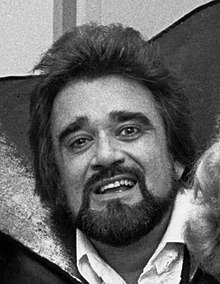 Wolfman Jack in 1979 | |
| Born | Robert Weston Smith (1938-01-21)January 21, 1938 Brooklyn, New York City, U.S. |
| Died | July 1, 1995(1995-07-01) (aged 57) Belvidere, Due north Carolina, U.S. |
| Occupation |
|
| Spouse(s) | Lucy "Lou" Lamb |
| Children | 2 |
Robert Weston Smith, known every bit Wolfman Jack (January 21, 1938 – July 1, 1995), was an American disc jockey.[1] Famous for his gravelly voice, he credited it for his success, saying, "Information technology'southward kept meat and potatoes on the table for years for Wolfman and Wolfwoman. A couple of shots of whiskey helps it. I've got that nice raspy sound."[2]
Early career [edit]
Smith was built-in in Brooklyn on January 21, 1938, the younger of two children of Anson Weston Smith, an Episcopal Sunday schoolhouse teacher, author, editor, and executive vice president of Financial World, and his married woman Rosamond Small. He lived on twelfth Street and 4th Avenue and went to Manual Training High School in the Park Slope section. His parents divorced while he was a child. To assistance keep him out of problem, his father bought him a large Trans-Oceanic radio, and Smith became an avid fan of R&B music and the disc jockeys who played it, including Douglas "Jocko" Henderson of Philadelphia, New York'south "Dr. Jive" (Tommy Smalls), the "Moon Dog" from Cleveland, Alan Freed, and Nashville's "John R." Richbourg, who later became his mentor. After selling encyclopedias and Fuller brushes door-to-door, Smith attended the National Academy of Broadcasting in Washington, D.C. After he graduated in 1960, he began working every bit "Daddy Jules" at WYOU in Newport News, Virginia. When the station format changed to "cute music", Smith became known as "Roger Gordon and Music in Skillful Taste". In 1962, he moved to country music station KCIJ/1050 in Shreveport, Louisiana, every bit the station manager and forenoon disc jockey, "Big Smith with the Records". He married Lucy "Lou" Lamb in 1961, and they had two children.[3]
Freed had originally called himself the "Moon Dog" subsequently New York City street musician Moondog. Freed both adopted this name and used a recorded howl to requite his early on broadcasts a unique character. Smith's adaptation of the Moondog theme was to call himself Wolfman Jack and add his own sound furnishings. The grapheme was based in part on the way and fashion of bluesman Howlin' Wolf. At KCIJ,at he beginning began to develop his famous alter ego Wolfman Jack. According to author Philip A. Lieberman, Smith's "Wolfman" persona "derived from Smith'southward love of horror films and his shenanigans every bit a 'wolfman' with his two immature nephews. The 'Jack' was added every bit a part of the 'hipster' lingo of the 1950s, equally in 'Take a page from my book, Jack,' or the more popular, 'Hit the road, Jack.'"[four]
In 1963, Smith took his deed to the border when the Inter-American Radio Advertizement'south Ramon Bosquez hired him and sent him to the studio and transmitter site of XERF-AM at Ciudad Acuña in United mexican states, a station across the U.S.-Mexico border from Del Rio, Texas, whose loftier-powered border blaster signal could be picked up across much of the United states. In an interview with writer Tom Miller, Smith described the reach of the XERF signal: "We had the virtually powerful betoken in North America. Birds dropped dead when they flew too close to the tower. A car driving from New York to 50.A. would never lose the station."[5] Most of the border stations broadcast at 250,000 watts, five times the U.S. limit, significant that their signals were picked up all over Northward America, and at night equally far away as Europe and the Soviet Spousal relationship. At XERF, Smith adult his signature way (with phrases such as, "Who's this on the Wolfman phone?") and widespread fame. The border stations fabricated money past renting time to Pentecostal preachers and psychics, and by taking l% of the profit from anything sold by mail service order. The Wolfman did pitches for dog food, weight-loss pills, weight-proceeds pills, rose bushes, and baby chicks. Even a pill called Florex, which was supposed to heighten one's sex activity drive, was sold. "Some zing for your ling nuts", the Wolfman would say.[vi]
That sales pitch was typical of Wolfman Jack's growling, exuberant on-air style. In the spirit of his grapheme name, he punctuated his barrack with howls, while urging his listeners to "get naked" or "lay your hands on the radio and squeeze my knobs". Office of the persona was his nocturnal anonymity; listeners from coast to coast had no idea how to recognize the confront behind the vocalism that said things such as, "Wolfman plays the best records in the business, and and so he eats 'em!"
XERB was the original phone call sign for the border blaster station in Rosarito Beach, United mexican states, which was branded equally The Mighty 1090 in Hollywood, California. The station boasted "50,000 watts of Boss Soul Power". That station continues to broadcast today with the call sign XEPRS-AM. XERB also had an office in the rear of a small-scale strip mall on Third Artery in Chula Vista, California. Information technology was non unlike the small broadcast studio depicted in the film American Graffiti (which was filmed at KRE in Berkeley). It was located but 10 minutes from the Tijuana–San Diego border crossing. The Wolfman was rumored to really broadcast from this location during the early to mid-1960s. Smith left Mexico later on viii months and moved to Minneapolis, Minnesota, to run station KUXL. Though Smith was managing a Minneapolis radio station, he was however broadcasting as Wolfman Jack on XERF via taped shows that he sent to the station. Missing the excitement, however, he returned to border radio to run XERB, and opened an office on Dusk Boulevard in the Los Angeles area in Jan 1966. The Wolfman recorded his shows in Los Angeles and shipped his tapes across the edge into Mexico, where they would then exist beamed across the U.Southward.[seven] During his time broadcasting on XERB, Smith met Don Kelley, who became his personal manager and business organisation partner for more than xx years. Kelley saw the potential for Wolfman Jack to become more than than a radio personality. Kelley started to work on a strategy to transform Smith from a cult effigy to a mainstream entertainer in moving-picture show, recordings, and television. He promoted Smith to the major media and formed enduring relationships with key journalists.
In 1971, the Mexican regime decided that its overwhelmingly Roman Cosmic citizens should not be subjected to proselytizing and banned the Pentecostal preachers from the radio, taking abroad eighty% of XERB's acquirement. Smith then moved to station KDAY 1580 in Los Angeles, which could only pay him a fraction of his former XERB income. Smith capitalized on his fame, though, by editing his old XERB tapes and selling them to radio stations everywhere, becoming i of the first rock-and-ringlet syndicated programs (equally the tapes began to historic period, they were eventually besides marketed to oldies stations). He also appeared on Armed Forces Radio from 1970 to 1986. At his peak, Wolfman Jack was heard on more than two,000 radio stations in 53 countries.[viii] He was heard as far off equally the Wild Coast, Transkei, on a station based in that location, Majuscule Radio 604.[ix] In a deal promoted by Don Kelley, the Wolfman was paid amply to join WNBC in New York in August 1973, the same calendar month that American Graffiti premiered, and the station did a huge advertising campaign in local newspapers stating that the Wolfman would propel their ratings over those of their primary competitor, WABC, which had "Cousin Brucie" (Bruce Morrow). The advertisements proclaimed, "Cousin Brucie's Days Are Numbered", and thousands of small, tombstone-shaped paperweights were distributed that said, "Cousin Brucie is going to be buried past Wolfman Jack".[10] [xi] After less than a year, WNBC hired Cousin Brucie, and Wolfman Jack went dorsum to California to concentrate on his syndicated radio evidence, which was carried on KRLA-Pasadena (Los Angeles) from 1984 to 1987. He moved to Belvidere, Northward Carolina, in 1989, to exist closer to his extended family unit.[12] In the 1980s, he did a brief stint at XEROK 80, another border-blaster station that was leased by Dallas investors Robert Hanna, Grady Sanders, and John Ryman. He also hosted a Tv set evidence at Footling Darlin's Rock n' Roll Palace, which was eventually renamed Wolfman Jack'southward Rock'due north'Roll Palace.[13] Ryman then moved Smith to Scott Ginsburg-owned Y95 in Dallas, Texas.
Recordings of Wolfman Jack's old shows were reintroduced to syndication a decade subsequently his death and remain available to local stations, through Envision Networks as of 2020.[xiv]
Moving picture, television, and music career [edit]
In his early days, Wolfman Jack made sporadic public appearances, usually every bit a master of ceremonies for rock bands at Los Angeles clubs. At each advent, he looked a niggling dissimilar because he had not decided what the Wolfman should look like. Early pictures show him with a goatee, but sometimes he combed his straight pilus forward and added dark makeup to look somewhat "indigenous". Other times he had a big afro wig and large sunglasses. The ambiguity of his race contributed to the controversy of his program. His audition finally got a good wait at him when he appeared in the 1969 film A Session with the Committee, a montage of skits past the comedy troupe The Committee.
Wolfman Jack started his recording career in Minneapolis while working at KUXL Radio in 1965 with George Garrett, who helped tape the album Boogie with the Wolfman past Wolfman Jack and the Wolfpack on the Staff of life Label. He was also responsible for engineering science, producing, and assembling the band.[15] Wolfman Jack also released Wolfman Jack (1972) and Through the Ages (1973) on the Wooden Nickel label.[16]
In 1973, he appeared as himself in George Lucas'due south second feature moving-picture show American Graffiti. Lucas gave him a fraction of a "signal", the segmentation of the profits from a film, and the extreme financial success of American Graffiti provided him with a regular income for life. He also appeared in the film's 1979 sequel More than American Graffiti, though just through voice-overs. In 1978, he appeared as Bob "The Jackal" Smith in a made-for-TV movie Deadman'southward Curve based on the musical careers of Jan Berry and Dean Torrence of January and Dean. Smith appeared in several television shows equally Wolfman Jack, including The Odd Couple, What's Happening!!, Vega$, Hollywood Squares, Married... with Children, Emergency!, The New Adventures of Wonder Woman, and Galactica 1980. He was the regular announcer and occasional host for The Midnight Special on NBC from 1973 to 1981. He was the host of his variety serial The Wolfman Jack Testify, which was produced in Canada by CBC Television receiver in 1976 and syndicated to stations in the U.South. He likewise voiced the chief of the Rama Lama tribe on the TV special Garfield in Paradise in 1986.
Jim Morrison's lyrics for "The WASP (Texas Radio and the Large Beat)" were influenced past Wolfman Jack'southward broadcasting. He is besides mentioned in the Grateful Dead vocal "Ramble On Rose".[17] He furnished his vocalisation in The Estimate Who's top-10 hit unmarried "Clap for the Wolfman". Wolfman Jack was regularly parodied on The Hilarious House of Frightenstein equally "The Wolfman", an bodily werewolf disc jockey with a look inspired by the original The Wolf Human movies. A few years earlier, Todd Rundgren recorded the tribute "Wolfman Jack" on the album Something/Annihilation?; the single version of the runway includes a shouted talk-over introduction past the Wolfman, simply on the album version, Rundgren performs that function himself. Canadian band The Stampeders also released a embrace of "Hit the Road Jack" in 1975 featuring Wolfman Jack. From 1975 to 1980, Wolfman Jack hosted Halloween Haunt at Knott'southward Berry Subcontract, which transforms itself into Knott's Scary Subcontract each year for Halloween. It was the about successful special effect of any theme park in the country, and often sold out.[18] [xix] [20]
In 2012, the manor of Wolfman Jack released a hip-hop single featuring Wolfman Jack clips as the vocals.[21] In 2016, clips from the Wolfman Jack Radio Program were used in the Rob Zombie film 31.[22]
Radio Caroline [edit]
When the i surviving ship in what had originally been a pirate radio network of Radio Caroline Due north and Radio Caroline South sank in 1980, a search began to find a replacement. Because of the laws passed in the UK in 1967, the sales functioning needed to be situated in the U.Due south. For a time, Don Kelley, Wolfman Jack's business partner and personal director, acted as the West Declension agent for the planned new Radio Caroline, simply the deal eventually fell apart.
Equally a role of this process, Wolfman Jack was fix to deliver the morn shows on the new station. To that end, he recorded a number of programs that never aired, because the station did non come on air according to schedule. (It eventually returned in 1983 from a new transport, which remained at sea until 1990.) Today, those tapes are traded amid collectors of his piece of work.[ citation needed ]
Decease [edit]
On July 1, 1995, Smith died from a eye set on at his house in Belvidere, Northward Carolina, shortly after finishing a weekly circulate.[2] [23] He is buried at a family cemetery in Belvidere.[24]
Filmography [edit]
| Yr | Title | Role | Notes |
|---|---|---|---|
| 1971 | The 7 Minutes | Himself | |
| 1973 | American Graffiti | Disc Jockey / Himself | |
| 1975 | Emergency! | Disc Jockey | "The Inspection" |
| 1978 | Sgt. Pepper'southward Alone Hearts Social club Ring | Our Guests At Heartland | |
| 1978 | Hanging on a Star | Gordon Shep | |
| 1978 | The New Adventures of Wonder Woman | Infra Cherry | "Disco Devil" |
| 1979 | More than American Graffiti | Himself | |
| 1980 | Motel Hell | Reverend Billy | |
| 1980 | Galactica 1980 | Himself | |
| 1985 | The Midnight Hour | Radio DJ | Made-for-boob tube motion picture |
| 1988 | Mortuary Academy | Bernie Berkowitz | |
| 1989 | Midnight | Himself | |
| 1992 | Swamp Thing | Hurly | "Children of the Fool" |
| 1995 | Married... with Children | Himself | "Transport Happens: Part 1" |
References [edit]
- ^ Herszenhorn, David 1000. (July 2, 1995). "Wolfman Jack, Raspy Vocalism Of the Radio, Is Expressionless at 57". The New York Times.
- ^ a b Bob Pinheiro (July ane, 1995). "Wolfman Jack, pioneer disc jockey dies at 57". Modestoradiomuseum.org. Archived from the original on July 27, 2011. Retrieved Baronial 18, 2015.
- ^ John A. Drobnicki, "Wolfman Jack (Robert Weston Smith)", in The Scribner Encyclopedia of American Lives, Vol. iv (Scribner's, 2001), p. 581.
- ^ Philip A. Lieberman, Radio's Morning Show Personalities: Early Hour Broadcasters and Deejays from the 1920s to the 1990s (McFarland & Company, 1996), p. 58.
- ^ Tom Miller. On the Border: Portraits of America's Southwestern Frontier, pp. 84–85.
- ^ Wes Smith, The Pied Pipers of Stone 'north' Scroll (Longstreet Press, 1989), p. 272.
- ^ Factor Fowler and Bill Crawford, Border Radio (Limelight Editions, 1990).
- ^ John A. Drobnicki, "Wolfman Jack (Robert Weston Smith)". in The Scribner Encyclopedia of American Lives, Vol. iv (Scribner'south, 2001), p. 582.
- ^ "Wolfman Jack in Africa, 1980. Borderblasting in a Bantustan". July 16, 2012. Archived from the original on July 16, 2012. Retrieved September 11, 2017.
- ^ Ben Fong-Torres, The Hits Just Keep on Coming: The History of Superlative 40 Radio (Miller Freeman Books, 1998), p. 142.
- ^ Paul Levinson (July 4, 1976). "Wolfman Hits the Route, Jack". The Hamlet Voice. p. 34.
- ^ James F. Mills, "Wolfman Turns into Country Admirer: Due north.C. Mansion Home to Stone 'n' Roll DJ", Charlotte Observer (February 27, 1994), p. 8B.
- ^ "Wolfman and 'Midnight': Nostalgia just No Regrets". Los Angeles Times. May 21, 1988. Retrieved June 30, 2021.
- ^ "The Wolfman Jack Radio Show". Envision Networks . Retrieved February v, 2020.
- ^ Minnesota Rocked, Tom Tourville, second Edition, 1983, LCCN 82-74566
- ^ Callahan, Mike; Edwards, David; Eyries, Patrice (October 26, 2005). "Wooden Nickel Album Discography". Archived from the original on January 13, 2010. Retrieved October 3, 2009.
- ^ "The Annotated "Ramble On Rose"". Artsites.ucsc.edu. Retrieved August 18, 2014.
- ^ Merritt, Christopher, and Lynxwiler, J. Eric. Knott's Preserved: From Boysenberry to Theme Park, the History of Knott's Berry Farm, pp. 126–29, Angel City Printing, Santa Monica, CA, 2010. ISBN 978-1-883318-97-0.
- ^ "Scary Farm". Ultimatehaunt.com. Retrieved August 18, 2014.
- ^ "Knott'south In Print: Halloween Haunt in the Beginning". Knottsinprint.blogspot.com. Oct 24, 2011. Retrieved August 18, 2014.
- ^ Archived at Ghostarchive and the Wayback Machine: Wolfman Jack – Topic (October 11, 2015). "Lay Your Hand On the Radio". Retrieved September 11, 2017 – via YouTube.
- ^ "'31' Review: Rob Zombie Makes Sickest Motion-picture show Still, Also His Nearly Fun". September two, 2016. Retrieved September eleven, 2017.
- ^ "A brusque synapses nearly Wolfman Jack, his accomplishments, and his life". Archived from the original on July 27, 2013.
- ^ "Kin Programme Park, Museum in Honor of Wolfman Jack". Deseret News. November 12, 1995. Retrieved Dec 23, 2018.
External links [edit]
- "New year'south Eve, 1993, With Wolfman Jack !"
- Wolfman Jack: The Mouth Heard 'Round the World (interview)
- Kip Pullman's American Graffiti Weblog
- Wolfman Jack and the gun battle in the Mexican desert
- What fabricated Wolfman Jack great?
- Wolfman Jack at IMDb
- Wolfman Jack at Observe a Grave
jacksonsmisprome1960.blogspot.com
Source: https://en.wikipedia.org/wiki/Wolfman_Jack
0 Response to "Wolfman Jack the Wolfman Howls Again"
Publicar un comentario