Art Term That Is Used for Objects That Are Reproduced

Appropriation in art is the use of pre-existing objects or images with little or no transformation applied to them.[1] The use of appropriation has played a significant function in the history of the arts (literary, visual, musical and performing arts). In the visual arts, to advisable means to properly adopt, borrow, recycle or sample aspects (or the entire grade) of human-made visual civilisation. Notable in this respect are the Readymades of Marcel Duchamp.
Inherent in our understanding of appropriation is the concept that the new work re-contextualizes whatsoever it borrows to create the new piece of work. In most cases, the original "thing" remains accessible equally the original, without alter.
Definition [edit]
Appropriation, similar to establish object art is "equally an creative strategy, the intentional borrowing, copying, and alteration of preexisting images, objects, and ideas".[ii] Information technology has likewise been defined as "the taking over, into a work of art, of a real object or even an existing work of fine art."[3] The Tate Gallery traces the practice dorsum to Cubism and Dadaism, and standing into 1940s Surrealism and 1950s Pop art. It returned to prominence in the 1980s with the Neo-Geo artists,[3] and is now common practice among contemporary artists like Richard Prince, Sherrie Levine, and Jeff Koons.[4]
History [edit]
19th century [edit]
Many artists fabricated references to works by previous artists or themes.
In 1856 Ingres painted the portrait of Madame Moitessier. The unusual pose is known to have been inspired by the famous ancient Roman wall painting Herakles Finding His Son Telephas. In doing so, the artist created a link between his model and an Olympian goddess.[half-dozen]
Edouard Manet painted the Olympia (1865) inspired by Titian Venus of Urbino. His painting Le Déjeuner sur l'herbe was too inspired by the work of the Old Masters. Its composition is based on a detail of Marcantonio Raimondi's 'The Judgement of Paris' (1515).[7]
Gustave Courbet is believed to have seen the famous color woodcut The Great Wave off Kanagawa past Japanese artist Katsushika Hokusai before painting a series of the Atlantic Body of water during the summer of 1869.[viii]
Vincent van Gogh tin can be named with the examples of the paintings he did inspired by Jean Francois Millet, Delacroix or the Japanese prints he had in his collection.[ix] In 1889, Van Gogh created xx painted copies inspired by Millet black-and-white prints. He enlarged the compositions of the prints then painted them in colour according to his own imagination. Vincent wrote in his messages that he had fix out to "translate them into another linguistic communication". He said that it was non simply copying: if a performer "plays some Beethoven he'll add together his personal interpretation to it… it isn't a hard and fast rule that only the composer plays his own compositions".[10] More examples can be found on Copies by Vincent van Gogh.
Claude Monet, a collector of Japanese prints, created several works inspired by these such as The Garden at Sainte-Adresse, 1867 inspired by Fuji from the Platform of Sasayedo by Katsushika Hokusai ; The Water Lily Swimming series Under Mannen Bridge at Fukagawa, 1830-1831 by Hokusai or La Japonaise, 1876 likely inspired by Kitagawa Tsukimaro Geisha, a pair of hanging scroll paintings, 1820-1829 .[11] [12] [13]
First half of the 20th century [edit]
In the early on twentieth century Pablo Picasso and Georges Braque appropriated objects from a not-art context into their work. In 1912, Picasso pasted a piece of oil cloth onto the canvass.[14] Subsequent compositions, such as Guitar, Newspaper, Glass and Bottle (1913) in which Picasso used paper clippings to create forms, is early collage that became categorized as part of synthetic cubism. The two artists incorporated aspects of the "existent world" into their canvases, opening upwardly discussion of signification and artistic representation.
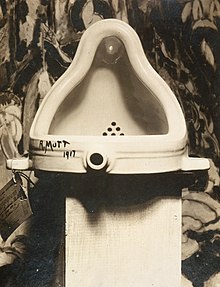
Marcel Duchamp in 1915 introduced the concept of the readymade, in which "industrially produced utilitarian objects...achieve the status of art merely through the process of selection and presentation."[xv] Duchamp explored this notion as early as 1913 when he mounted a stool with a bicycle wheel and again in 1915 when he purchased a snowfall shovel and inscribed it "in advance of the broken arm, Marcel Duchamp."[16] [17] In 1917, Duchamp organized the submission of a readymade into the Society of Independent Artists exhibition under the pseudonym, R. Mutt.[xviii] Entitled Fountain, it consisted of a porcelain urinal that was propped atop a pedestal and signed "R. Mutt 1917". The piece of work posed a direct challenge, starkly juxtaposing to traditional perceptions of fine art, ownership, originality and plagiarism, and was later on rejected past the exhibition committee.[19] The New York Dada magazine The Bullheaded Homo defended Fountain, claiming "whether Mr. Mutt with his ain hands made the fountain or not has no importance. He CHOSE it.[20] He took an ordinary commodity of life, placed it so that its useful significance disappeared under the new title and betoken of view—and created a new idea for that object."[19]
The Dada movement continued to play with the appropriation of everyday objects and their combination in collage. Dada works featured deliberate irrationality and the rejection of the prevailing standards of art. Kurt Schwitters shows a similar sensibility in his "merz" works. He constructed parts of these from found objects,[21] and they took the form of large gesamtkunstwerk constructions that are now called installations.
During his Squeamish Period (1908–13), Henri Matisse painted several paintings of odalisques, inspired past Delacroix Women of Algiers.[22] [23] [24]
The Surrealists, coming after the Dada move, also incorporated the use of 'establish objects', such every bit Méret Oppenheim's Object (Luncheon in Fur) (1936) or Salvador Dalí's Lobster Telephone (1936). These constitute objects took on new meaning when combined with other unlikely and unsettling objects.
1950–1960: Pop art and realism [edit]

In the 1950s, Robert Rauschenberg used what he dubbed "combines", combining readymade objects such as tires or beds, painting, silk-screens, collage, and photography. Similarly, Jasper Johns, working at the same time as Rauschenberg, incorporated found objects into his work.
In 1958 Bruce Conner produced the influential A Movie in which he recombined existing picture show clips. In 1958 Raphael Montanez Ortiz produced Cowboy and Indian Film, a seminal appropriation pic work.[ citation needed ]
The Fluxus art movement likewise utilized appropriation:[ citation needed ] its members blended different creative disciplines including visual fine art, music, and literature. Throughout the 1960s and 1970s they staged "activeness" events and produced sculptural works featuring unconventional materials.
In the early on 1960s artists such as Claes Oldenburg and Andy Warhol appropriated images from commercial art and popular civilization equally well as the techniques of these industries with for example Warhol painting Coca-Cola bottles.[25] Chosen "popular artists", they saw mass popular culture as the main vernacular culture, shared past all irrespective of education. These artists fully engaged with the ephemera produced from this mass-produced culture, embracing expendability and distancing themselves from the testify of an creative person'south hand.
Among the about famous pop artists, Roy Lichtenstein became known for appropriating pictures from comics books with paintings such as Masterpiece (1962) or Drowning Girl (1963) and from famous artists such as Picasso or Matisse.[26]
Elaine Sturtevant (likewise known simply equally Sturtevant), on the other mitt, created replicas of famous works past her contemporaries. Artists she 'copycatted' included Warhol, Jasper Johns, Joseph Beuys, Duchamp, James Rosenquist, Roy Lichtenstein, and more. While not exclusively reproducing Pop Art, that was a significant focus of her practice.[27] She replicated Andy Warhol'southward Flowers in 1965 at the Bianchini Gallery in New York. She trained to reproduce the creative person's own technique—to the extent that when Warhol was repeatedly questioned on his technique, he once answered "I don't know. Ask Elaine."[28]
In Europe, a grouping of artists chosen the New Realists used objects such equally the sculptor Cesar[29] who compressed cars to create monumental sculptures or the artist Arman[30] who included everyday automobile-made objects—ranging from buttons and spoons to automobiles and boxes filled with trash.
The German language artists Sigmar Polke and his friend Gerhard Richter who divers "Capitalist Realism," offered an ironic critique of consumerism in mail-war Germany. They used pre existing photographs and transformed them. Polke's best-known works were his collages of imagery from pop culture and advertizing, similar his "Supermarkets" scene of super heroes shopping at a grocery store.[31]
1970–1980: The Picture Generation and Neo Pop [edit]
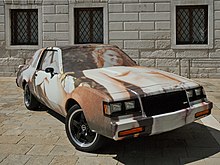
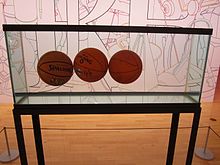
Whilst appropriation in bygone eras utilised the likes of 'language', contemporary cribbing has been symbolised by photography every bit a means of 'semiotic models of representation'.[32] The Pictures Generation was a group of artists, influenced by Conceptual and Popular art, who utilized appropriation and montage to reveal the constructed nature of images.[33] An exhibition named The Pictures Generation, 1974–1984 was held at The Metropolitan Museum of Art (The Met) in New York City from April 29 – Baronial 2, 2009 that included among other artists John Baldessari, Barbara Kruger, Sherrie Levine, Richard Prince, David Salle, Cindy Sherman.
Sherrie Levine, who addressed the act of appropriating itself as a theme in art.[34] Levine ofttimes quotes entire works in her own work, for case photographing photographs of Walker Evans. Challenging ideas of originality, drawing attention to relations betwixt power, gender and creativity, consumerism and commodity value, the social sources and uses of art, Levine plays with the theme of "almost same".
During the 1970s and 1980s Richard Prince re-photographed advertisements such as for Marlboro cigarettes[35] or photo-journalism shots. His piece of work takes anonymous and ubiquitous cigarette billboard advertising campaigns, elevates the condition and focuses our gaze on the images.
Appropriation artists annotate on all aspects of civilization and club. Joseph Kosuth appropriated images to appoint with epistemology and metaphysics.
Other artists working with appropriation during this fourth dimension with included Greg Colson, and Malcolm Morley.[ citation needed ]
In the tardily 1970s Dara Birnbaum was working with cribbing to produce feminist works of art.[36] In 1978-79 she produced one of the first video appropriations. Technology/Transformation: Wonder Adult female utilised video clips from the Wonder Woman television series.[37]
Richard Pettibone began replicating on a miniature calibration works by newly famous artists such every bit Andy Warhol, and later on likewise modernist masters, signing the original artist's name every bit well as his own.[38] [31]
Jeff Koons gained recognition in the 1980 by creating conceptual sculptures The New serial, a series of vacuum-cleaners, often selected for brand names that appealed to the artist like the iconic Hoover, and in the vein of the readymades of Duchamp. Later he created sculptures in stainless steel inspired past inflatable toys such as bunnies or dogs.[39] [40]
1990s [edit]

In the 1990s artists continued to produce appropriation art, using it as a medium to accost theories and social issues, rather than focussing on the works themselves. Damian Loeb used pic and movie house to comment on themes of simulacrum and reality. Other loftier-profile artists working at this time included Christian Marclay, Deborah Kass, and Genco Gulan.[41]
Yasumasa Morimura is a Japanese cribbing creative person who borrows images from historical artists (such equally Édouard Manet or Rembrandt) to modernistic artists equally Cindy Sherman, and inserts his own face and body into them.[42]
Sherrie Levine appropriated the appropriated when she made polished bandage statuary urinals named Fountain. They are considered to be an "homage to Duchamp's renowned readymade. Calculation to Duchamp's audacious move, Levine turns his gesture dorsum into an "art object" past elevating its materiality and end. As a feminist artist, Levine remakes works specifically past male artists who commandeered patriarchal dominance in art history."[43]
21st century [edit]
Appropriation is frequently used by gimmicky artists who often reinterpret previous artworks such as French artist Zevs who reinterpreted logos of brands like Google or works past David Hockney.[44] Many urban and street artists also use images from the popular culture such equally Shepard Fairey or Banksy,[45] who appropriated artworks by Claude Monet or Vermeer with his daughter with a pierced eardrum.[46]
Canadian Cree creative person Kent Monkman appropriates iconic paintings from European and North American fine art history and populates them with Indigenous visions of resistance.[47]
In 2014 Richard Prince released a series of works titled New Portraits appropriating the photos of anonymous and famous persons (such equally Pamela Anderson) who had posted a selfie on Instagram.The modifications to the images past the creative person are the comments Prince added nether the photos.[48] [49]
Damien Hirst was accused in 2018 of appropriating the work of Emily Kngwarreye and others from the painting community in Utopia, Northern Territory with the Veil paintings, that according to Hirst were "inspired by Pointillist techniques and Impressionist and Post-Impressionist painters such as Bonnard and Seurat".[l] [51] [52] [53]
Mr. Brainwash[54] is an urban artist who became famous thank you to Banksy and whose fashion fuses historic pop imagery and contemporary cultural iconography to create his version of a pop–graffiti art hybrid first popularized by other street artists.[55]
Brian Donnelly, known as Kaws, has used cribbing in his series, The Kimpsons, and painted The Kaws Anthology inspired by the Simpsons Yellow Album which itself was a parody of the cover art for the Beatles anthology Sgt. Pepper's Alone Hearts Guild Band replaced with characters from the Simpsons.[56] On April i, 2019, at Sotheby'south in Hong Kong, The Kaws Album (2005), sold for 115.nine one thousand thousand Hong Kong dollars, or about $14.seven meg U.Southward. dollars.[57] In improver, he has reworked other familiar characters such as Mickey Mouse, the Michelin Man, the Smurfs, Snoopy, and SpongeBob SquarePants.[58]
In the digital historic period [edit]
Since the 1990s, the exploitation of historical precursors is as multifarious every bit the concept of appropriation is unclear. An unparalleled quantity of appropriations pervades not simply the field of the visual arts, merely of all cultural areas. The new generation of appropriators considers themselves "archeolog[es] of the present time".[59] Some speak of "postproduction", which is based on pre-existing works, to re-edit "the screenplay of culture".[60] The annexation of works made by others or of bachelor cultural products more often than not follows the concept of utilise. Then-called "prosumers"[61]—those consuming and producing at the same time—browse through the ubiquitous archive of the digital world (more than seldom through the analog 1), in order to sample the ever attainable images, words, and sounds via 'copy-paste' or 'elevate-drop' to 'bootleg', 'mashup' or 'remix' them just as one likes. French curator Nicolas Bourriaud coined the neologism Semionaut – a portmanteau of semiotics and astronaut – to describe this. He writes: "DJs, Web surfers, and postproduction artists imply a similar configuration of knowledge, which is characterized by the invention of paths through culture. All three are "semionauts" who produce original pathways through signs."[62] Appropriations have today become an everyday phenomenon.
The new "generation remix"[63]—who take taken the stages non only of the visual arts, but likewise of music, literature, dance and film—causes, of course, highly controversial debates. Media scholars Lawrence Lessig coined in the begin of the 2000s here the term of the remix civilization.[64] On the one mitt are the celebrators who foresee a new age of innovative, useful, and entertaining ways for art of the digitized and globalized 21st century. The new appropriationists will not only realize Joseph Beuys' dictum that everyone is an artist but also "build free societies".[65] By liberating art finally from traditional concepts such every bit aura, originality, and genius, they will lead to new terms of understanding and defining fine art. More than disquisitional observers encounter this as the starting point of a huge problem. If cosmos is based on nothing more than carefree processes of finding, copying, recombining and manipulating pre-existing media, concepts, forms, names, etc. of any source, the understanding of art volition shift in their sight to a trivialized, depression-demanding, and regressive action. In view of the limitation of fine art to references to pre-existing concepts and forms, they foresee endless recompiled and repurposed products. Skeptics telephone call this a civilisation of recycling with an addiction to the past[66]
Some say that only lazy people who accept nothing to say permit themselves be inspired by the by in this way.[67] Others fearfulness, that this new trend of appropriation is caused by zip more than the wish of embellishing oneself with an attractive genealogy.[68] The term appropriationism [69] reflects the overproduction of reproductions, remakings, reenactments, recreations, revisionings, reconstructings, etc. by copying, imitating, repeating, quoting, plagiarizing, simulating, and adapting pre-existing names, concepts and forms. Appropriationism is discussed—in comparison of appropriation forms and concepts of the 20th century which offering new representations of established noesis[70]—as a kind of "racing standstill",[71] referring to the acceleration of random, uncontrollable operations in highly mobilised, fluid Western societies that are governed more and more by abstruse forms of control. Unlimited access to the digital archive of creations and easily feasible digital technologies, as well as the priority of fresh ideas and creative processes over a perfect masterpiece leads to a hyperactive hustle and bustle around the by instead of launching new expeditions into unexplored territory that could requite visibility to the forgotten ghosts and ignored phantoms of our common myths and ideologies.
Appropriation fine art and copyright [edit]
Cribbing fine art has resulted in contentious copyright issues regarding its validity under copyright police force. The U.South. has been specially litigious in this respect. A number of example law examples have emerged that investigate the partitioning between transformative works and derivative works.[72]
What is fair utilise? [edit]
The Copyright Human activity of 1976 in the Usa, provides a defence against copyright infringement when an creative person can prove that their use of the underlying work is "off-white".
The Act gives 4 factors to be considered to determine whether a particular employ is a fair utilize:
- the purpose and character of the use (commercial or educational, transformative or reproductive, political);
- the nature of the copyrighted work (fictional or factual, the degree of creativity);
- the corporeality and substantiality of the portion of the original piece of work used; and
- the consequence of the use upon the market (or potential market) for the original piece of work.
Examples of lawsuits [edit]
Andy Warhol faced a series of lawsuits from photographers whose work he appropriated and silk-screened. Patricia Caulfield, one such lensman, had taken a movie of flowers for a photography sit-in for a photography mag. Without her permission, Warhol covered the walls of Leo Castelli's New York gallery with his silk-screened reproductions of Caulfield's photo in 1964. Later seeing a poster of Warhol's unauthorized reproductions in a bookstore, Caulfield sued Warhol for violating her rights as the copyright possessor, and Warhol made a cash settlement out of courtroom.[73]
In 2021, the Second Circuit held that Warhol'southward use of a photo of Prince to create a series of 16 silkscreens and pencil illustrations was not fair use. The photograph, taken by celebrity photographer Lynn Goldsmith, was deputed in 1981 every bit an artist reference for Newsweek mag. In 1984, Warhol used the photograph as a source to create a piece of work for Vanity Off-white along with 15 additional pieces. Goldsmith was not made aware of the series until subsequently the musician's expiry in 2016, when Condé Nast published a tribute featuring one of Warhol's works. In its opinion, the Court held that each of the four "fair utilise" factors favored Goldsmith, further finding that the works were substantially similar equally a matter of law, given that "any reasonable viewer . . . would have no difficulty identifying the [Goldsmith photograph] as the source material for Warhol's Prince Series."[74]
On the other hand, Warhol's famous Campbell'south Soup Cans are more often than not held to be a not-infringing fair utilize of the soup maker's trademark, despite beingness clearly appropriated, because "the public [is] unlikely to see the painting every bit sponsored by the soup company or representing a competing production. Paintings and soup cans are not in themselves competing products," according to proficient trademark lawyer Jerome Gilson.[75]
Jeff Koons has also confronted issues of copyright due to his appropriation work (come across Rogers 5. Koons). Photographer Art Rogers brought suit confronting Koons for copyright infringement in 1989. Koons' work, String of Puppies sculpturally reproduced Rogers' black-and-white photograph that had appeared on an airport greeting card that Koons had bought. Though he claimed fair employ and parody in his defense, Koons lost the instance, partially due to the tremendous success he had as an artist and the manner in which he was portrayed in the media.[ citation needed ] The parody argument also failed, equally the appeals court drew a distinction betwixt creating a parody of modernistic society in general and a parody directed at a specific work, finding parody of a specific work, especially of a very obscure i, too weak to justify the fair use of the original.
In October 2006, Koons successfully dedicated a different work by claiming "fair use". For a 7-painting commission for the Deutsche Guggenheim Berlin, Koons drew on part of a photo taken by Andrea Blanch titled Silk Sandals by Gucci and published in the Baronial 2000 issue of Allure mag to illustrate an article on metal makeup. Koons took the image of the legs and diamond sandals from that photo (omitting other background details) and used it in his painting Niagara, which as well includes 3 other pairs of women'southward legs dangling surreally over a mural of pies and cakes.
In his decision, Guess Louis Fifty. Stanton of U.S. District Court found that Niagara was indeed a "transformative employ" of Blanch's photograph. "The painting's use does non 'supplant' or duplicate the objective of the original", the judge wrote, "but uses it as raw fabric in a novel manner to create new information, new aesthetics and new insights. Such employ, whether successful or non artistically, is transformative."
The detail of Blanch's photograph used past Koons is merely marginally copyrightable. Blanch has no rights to the Gucci sandals, "maybe the near hitting element of the photograph", the judge wrote. And without the sandals, simply a representation of a woman'southward legs remains—and this was seen as "not sufficiently original to deserve much copyright protection."
In 2000, Damien Hirst's sculpture Hymn (which Charles Saatchi had bought for a reported £1m) was exhibited in Ant Noises in the Saatchi Gallery. Hirst was sued for breach of copyright over this sculpture. The field of study was a 'Immature Scientist Anatomy Set' belonging to his son Connor, x,000 of which are sold a year past Hull (Emms) Toy Manufacturer. Hirst created a 20-foot, six-ton enlargement of the Science Set up effigy, radically changing the perception of the object. Hirst paid an undisclosed sum to 2 charities, Children Nationwide and the Toy Trust in an out-of-court settlement. The charitable donation was less than Emms had hoped for. Hirst sold three more copies of his sculpture for similar amounts to the get-go.[76]
Appropriating a familiar object to make an art work can prevent the artist claiming copyright ownership. Jeff Koons threatened to sue a gallery under copyright, claiming that the gallery infringed his proprietary rights by selling bookends in the shape of balloon dogs.[77] Koons abandoned that claim after the gallery filed a complaint for declaratory relief stating, "As nigh whatever clown can attest, no one owns the idea of making a airship dog, and the shape created by twisting a balloon into a dog-similar grade is part of the public domain."[78]
In 2008, photojournalist Patrick Cariou sued creative person Richard Prince, Gagosian Gallery and Rizzoli books for copyright infringement. Prince had appropriated forty of Cariou's photos of Rastafari from a volume, creating a series of paintings known as Canal Zone. Prince variously contradistinct the photos, painting objects, oversized easily, naked women and male torsos over the photographs, later selling over $10 million worth of the works. In March 2011, a estimate ruled in favor of Cariou, but Prince and Gargosian appealed on a number of points. 3 judges for the U.S. Court of Appeals upheld the right to an entreatment.[79] Prince'southward attorney argued that "Appropriation art is a well-recognized mod and postmodern art class that has challenged the way people think almost art, challenged the way people call back almost objects, images, sounds, culture"[lxxx] On April 24, 2013, the appeals court largely overturned the original decision, deciding that many of the paintings had sufficiently transformed the original images and were therefore a permitted utilise.[81] See Cariou v. Prince. [82]
In November 2010, Chuck Close threatened legal activeness against computer artist Scott Blake for creating a Photoshop filter that built images out of dissected Chuck Close paintings.[83] [84] The story was first reported by online arts magazine Hyperallergic, it was reprinted on the front page of Salon.com, and spread rapidly through the web.[85] Kembrew McLeod, author of several books on sampling and appropriation, said in Wired that Scott Blake'south art should fall under the doctrine of off-white apply.[86]
In September 2014, U.S. Court of Appeals for the Seventh Excursion questioned the Second Excursion's interpretation of the fair utilize doctrine in the Cariou case. Of detail note, the Seventh Circuit noted that "transformative employ" is non i of the 4 enumerated fair use factors but is, rather, simply role of the get-go off-white use factor which looks to the "purpose and character" of the utilise. The 7th Circuit'south critique lends credence to the statement that in that location is a split among U.S. courts as to what role "transformativeness" is to play in any fair employ inquiry.[82]
In 2013, Andrew Gilden and Timothy Greene published a police force review article in The University of Chicago Law Review dissecting the factual similarities and legal differences between the Cariou case and the Salinger v. Colting case, articulating concerns that judges may be creating a off-white utilize "privilege largely reserved for the rich and famous."[87]
Artists using appropriation [edit]
The following are notable artists known for their use of pre-existing objects or images with footling or no transformation applied to them:
- ABOVE
- Ai Kijima
- Aleksandra Mir
- Andy Warhol
- Banksy
- Barbara Kruger
- Benjamin Edwards
- Bern Porter
- Nib Jones
- Brian Dettmer
- Burhan Dogancay
- Christian Marclay
- Cindy Sherman
- Claes Oldenburg
- Cornelia Sollfrank
- Cory Arcangel
- Craig Baldwin
- Damian Loeb
- Damien Hirst
- David Salle
- Deborah Kass
- Dominique Mulhem
- Dorothy Cantankerous
- Douglas Gordon
- Elaine Sturtevant
- Eric Doeringer
- Fatimah Tuggar
- Felipe Jesus Consalvos
- Genco Gulan
- General Idea
- George Pusenkoff
- Georges Braque
- Gerhard Richter
- Ghada Amer
- Glenn Chocolate-brown
- Gordon Bennett
- Graham Rawle
- Graig Kreindler
- Greg Colson
- Hank Willis Thomas
- Hans Haacke
- Hans-Peter Feldman
- J. Tobias Anderson
- Jake and Dinos Chapman
- James Cauty
- Jasper Johns
- Jeff Koons
- Jim Ricks
- Joan Miró
- Jodi
- John Baldessari
- John McHale
- John Stezaker
- Joseph Cornell
- Joseph Kosuth
- Joy Garnett
- Kaws
- Karen Kilimnik
- Kelley Walker
- Kenneth Goldsmith
- Kurt Schwitters
- Lennie Lee
- Leon Golub
- Louise Lawler
- Luc Tuymans
- Luke Sullivan
- Malcolm Morley
- Marcel Duchamp
- Marcus Harvey
- Mark Divo
- Marlene Dumas
- Martin Arnold
- Matthieu Laurette
- Max Ernst
- Meret Oppenheim
- Mic Neumann
- Michael Landy
- Michel Platnic
- Mike Bidlo
- Mike Kelley
- Miltos Manetas
- Mohammad Rakibul Hasan
- Nancy Spero
- Negativland
- Nikki S. Lee
- Norm Magnusson
- PJ Crook
- Pablo Picasso
- Sigmar Polke
- People Like The states
- Peter Saville
- Philip Taaffe
- Pierre Bismuth
- Pierre Huyghe
- Reginald Case
- Richard Prince
- Rick Prelinger
- Rob Scholte
- Robert Longo
- Robert Rauschenberg
- Shepard Fairey
- Sherrie Levine
- Stephanie Syjuco
- Arrangement D-128
- Ted Noten
- Thomas Ruff
- Tom Phillips
- Vermibus
- Vik Muniz
- Vikky Alexander
- Vivienne Westwood
- Yasumasa Morimura
Run across also [edit]
- Fine art intervention
- Assemblage
- Classificatory disputes well-nigh art
- Collage
- Conceptual art
- Copies past Vincent van Gogh
- Cultural cribbing
- Decollage
- Off-white use
- Found object
- Postmodern art
- Scratch video
References [edit]
- ^ Chilvers, Ian & Glaves-Smith, John eds., Dictionary of Modern and Contemporary Art, Oxford: Oxford University Press, 2009. pp. 27–28
- ^ "MoMA | Glossary of Art Terms". www.moma.org . Retrieved 2020-08-17 .
- ^ a b Wilson, Simon; Lack, Jessica (2008), The Tate Guide to Modern Art Terms, London: Tate Publishing Ltd, pp. xx–21, ISBN978-1-85437-750-0
- ^ Tate. "Appropriation – Fine art Term". Tate Etc . Retrieved 2020-08-18 .
- ^ Tomkins, Duchamp: A Biography, p. 186.
- ^ "1856 – Jean-Auguste-Dominique Ingres, Madame Moitessier | Manner History Timeline". fashionhistory.fitnyc.edu . Retrieved 2021-04-04 .
- ^ "Le Dejeuner Sur L'Herbe (The Dejeuner on the Grass) by Edouard Manet". edouard-manet.net . Retrieved 2021-04-04 .
- ^ "Japonism: This Is What Claude Monet'southward Fine art Has in Common with Japanese Art". TheCollector. 2020-09-01. Retrieved 2021-04-04 .
- ^ "The artist whom Van Gogh almost admired—and whose work fetched record prices". theartnewspaper.com . Retrieved 2021-04-04 .
- ^ "816 (818, 613): To Theo van Gogh. Saint-Rémy-de-Provence, on or well-nigh Sun, 3 November 1889. - Vincent van Gogh Letters". vangoghletters.org . Retrieved 2021-04-04 .
- ^ Covenantarthistory (2016-04-23). "Talking Objects: Claude Monet and the Ascension of Japonism". Talking Objects . Retrieved 2021-04-04 .
- ^ "How Japanese Art Influenced and Inspired European Impressionist Artists". My Modern Met. 2017-12-fourteen. Retrieved 2021-04-04 .
- ^ "Japonisme". metmuseum.org. Oct 2004. Archived from the original on 2004-10-xiv. Retrieved 2021-04-04 .
- ^ "Exploring the Cutting-Edge History and Evolution of Collage Fine art". My Mod Met. 2017-07-14. Retrieved 2019-09-25 .
- ^ Elger, D. (2006). Dadaism. Koln: Taschen, pp. 80
- ^ Evans, D (ed.).(2009). Cribbing: Documents of contemporary art. London and Cambridge: Whitechapel Gallery and the MIT Press, pp. 40
- ^ Cabanne, P., and Snowdon, P. (1997). Duchamp & Co. Paris: Terrail, pp. 105
- ^ Cabanne, P., and Snowdon, P. (1997). Duchamp & Co. Paris: Terrail, pp. 114
- ^ a b Plant, Southward. (1992). The most radical gesture: The Situationist International in a postmodern age. London and New York: Routledge, pp.44
- ^ Arturo Schwarz, The complete works of Marcel Duchamp, New York, Delano Greenidge, 2000
- ^ The Collages of Kurt Schwitters, Dietrich, Cambridge University Press 1993, p6-7
- ^ Gotthardt, Alexxa (2018-09-10). "Understanding Eugène Delacroix through 5 of His Virtually Provocative Artworks". Cocked . Retrieved 2021-04-04 .
- ^ Eisenman, Stephen F. (2018-11-01). "Delacroix's Modernism". ARTnews . Retrieved 2021-04-04 .
- ^ "Henri Matisse (1869–1954)". metmuseum.org. Archived from the original on 2004-ten-25. Retrieved 2021-04-04 .
- ^ "Andy Warhol | Green Coca-Cola Bottles". whitney.org . Retrieved 2021-04-04 .
- ^ "Roy Lichtenstein Foundation – Roy Lichtenstein Foundation". lichtensteinfoundation.org . Retrieved 2019-09-06 .
- ^ Cotter, Kingdom of the netherlands (2014-11-13). "Taking Copycatting to a Higher Level". The New York Times. ISSN 0362-4331. Retrieved 2021-06-01 .
- ^ Hans Ulrich Obrist (19 May 2014). "Elaine Sturtevant obituary". The Guardian.
- ^ "César | French sculptor". Encyclopædia Britannica . Retrieved 2019-09-06 .
- ^ "Arman | French-American artist". Encyclopædia Britannica . Retrieved 2019-09-06 .
- ^ a b "The Art of Copying: Ten Masters of Appropriation". Cocked. 2014-02-xi. Retrieved 2019-09-06 .
- ^ Linden, Liz (Wintertime 2016). "Reframing Pictures: Reading the Art of Appropriation". Fine art Journal. 75 (four): 40–57. doi:10.1080/00043249.2016.1269561. JSTOR 45142821. S2CID 193684743. Retrieved 25 August 2021.
- ^ "The Pictures Generation Movement Overview". The Fine art Story . Retrieved 2019-09-06 .
- ^ "Sherrie Levine Paintings, Bio, Ideas". The Art Story . Retrieved 2021-04-04 .
- ^ Cohen, Alina (2018-03-02). "Who Really Shot Richard Prince'south Iconic Cowboys?". Artsy . Retrieved 2020-03-06 .
- ^ Welchman, John (2013). Art Afterwards Appropriation: Essays on Fine art in the 1990s. Routledge. pp. 33, 190. ISBN978-one-136-80136-v.
- ^ Meigh-Andrews, Chris (2013). A History of Video Art (2nd ed.). London: Bloomsbury Publishing. p. 194. ISBN978-0-85785-188-8.
- ^ "Richard Pettibone – 88 Artworks, Bio & Shows on Artsy". cocked.internet . Retrieved 2019-09-06 .
- ^ "Jeff Koons Biography, Life & Quotes". The Art Story . Retrieved 2019-09-06 .
- ^ "Jeff Koons | Biography, Art, & Facts". Encyclopædia Britannica . Retrieved 2019-09-06 .
- ^ Graf, Marcus (October 6, 2013). "Cocky Portrait? past Genco Gülan". Visual Art Vanquish.
- ^ Rosenberg, Karen (15 January 2015). "Yasumasa Morimura". The New York Times.
- ^ "Fountain (Buddha) - Sherrie Levine | The Broad". www.thebroad.org . Retrieved 2020-08-18 .
- ^ "Upcoming: Zevs – "The Large Oil Splash" @ Lazarides Rathbone « Arrested Motion". ArrestedMotion . Retrieved 2019-09-06 .
- ^ "The Story Behind Banksy". Smithsonian . Retrieved 2019-09-06 .
- ^ "Banksy Street Art in Bristol – VisitBristol.co.uk". Visit Bristol . Retrieved 2019-09-06 .
- ^ Madill, Shirley (2022). Kent Monkman: Life & Work. Toronto: Art Canada Institute. ISBN978-1-4871-0280-7.
- ^ Parkinson, Hannah Jane (2015-07-eighteen). "Instagram, an creative person and the $100,000 selfies – cribbing in the digital age". The Guardian. ISSN 0261-3077. Retrieved 2020-03-06 .
- ^ Plaugic, Lizzie (2015-05-xxx). "The story of Richard Prince and his $100,000 Instagram art". The Verge . Retrieved 2020-03-06 .
- ^ "Damien Hirst's latest artworks 'washed exactly similar my people'southward story', Indigenous creative person claims". Australian Broadcasting Corporation. 2018-03-28. Retrieved 2020-09-13 .
- ^ "The art of appropriation". THE ETHICS Centre. 2018-05-14. Retrieved 2020-09-xiii .
- ^ "Did Damien Hirst Rip Off Ancient Australian Artists's Work? | Frieze". frieze. 3 Apr 2018. Retrieved 2020-09-13 .
- ^ "'Uncanny similarity': new Damien Hirst works in spot of carp in Australia". The Guardian. 2018-03-29. Retrieved 2020-09-13 .
- ^ Geoghegan, Kev (2012-08-03). "Mr Brainwash makes U.k. show debut". Retrieved 2019-09-06 .
- ^ "Mr. Brainwash – "life is beautiful" Exhibition". Obey Giant. 2008-06-sixteen. Retrieved 2019-09-06 .
- ^ Adair, Torsten (2019-xi-19). "Syndicated Comics". The Beat . Retrieved 2020-02-28 .
- ^ Armstrong, Annie (2019-04-01). "$14.vii M. KAWS Painting Smashes Auction Record in Hong Kong". ARTnews . Retrieved 2020-02-28 .
- ^ "x things to know about KAWS | Christie's". www.christies.com . Retrieved 2020-02-28 .
- ^ Paolo Bianchi, quoted by Hedinger J.; Meyer, T. (2011). "Introduction to Whats adjacent". Kadmos. Retrieved fifteen Feb 2016.
{{cite web}}: CS1 maint: uses authors parameter (link) - ^ Bourriaud, Nicolas (2002). Postproduction. Culture as screenplay. How art reprograms the world. New York: Lucas & Sternberg.
- ^ cf. Toffler, Alvin (1980). The third wave. The classic study of tomorrow. New York: Bantam.
- ^ Bourriaud, Nicolas (2005). Postproduction : civilization every bit screenplay : how art reprograms the world. Caroline Schneider, Jeanine Herman (2nd ed.). New York: Lukas & Sternberg. p. xix. ISBN0-9745688-9-ix. OCLC 63165534.
- ^ Djordjevic, V.; Dobusch, L., eds. (2014). Generation Remix. iRights Media.
- ^ Download Lessig'south Remix, So Remix Information technology on wired.com (May 2009)
- ^ Hardy, Due south. "Rip!: A Remix Manifesto". Creative Generalist . Retrieved xv February 2016.
- ^ cf. Reynolds, Simon (2011). Retro Mania Pop Culture's Addiction To Its Own Past. London: Faber & Faber. ISBN9780865479944.
- ^ Albini, Steve, quoted by Benjamin Franzen; Kembrew McLeod (2009). Copyright Criminals. documentary motion-picture show.
{{cite book}}: CS1 maint: uses authors parameter (link) - ^ cf. Diedrichsen, Diedrich (September 2008). "Showfreaks und Monster". Texte zur Kunst. Artists' Artists. No. 71: 150.
- ^ Aden, Maike (April 2016). "Allow'south trip the light fantastic like we used to.... A critical intervention on a new tendency of Appropriationism" (PDF). Kunstchronik. No. 4: 201.
- ^ Aden, Maike (Summer 2016). "Ulises Carrión Carries On!". Journal of Artists' Books (JAB). No. twoscore, in prep.
- ^ cf. Virilio, Paul (1992). Rasender Stillstand. München: Hanser.
- ^ Meiselman, Jessica (2017-12-28). "When Does an Artist'south Appropriation Become Theft?". Artsy . Retrieved 2019-09-25 .
- ^ "Andy Warhol's Blossom Paintings".
- ^ Andy Warhol Constitute. for Visual Arts, Inc. v. Goldsmith, xi F.4th 26, 54 (2d Cir. 2021)
- ^ as quoted in Grant, Daniel, The Business of Being an Creative person (New York: Allworth Press, 1996), p. 142
- ^ "top-10-appropriation-artworks". artlyst.com . Retrieved 2019-12-08 .
- ^ Whiting, Sam (February four, 2011). "Jeff Koons' airship-dog claim ends with a whimper". The San Francisco Relate.
- ^ ALLEN, EMMA (Jan 21, 2011). "6 Hilarious Zingers From the Balloon-Dog Freedom Conform Filed Confronting Jeff Koons". BlouinArtinfo.
- ^ Corbett, Rachel; "A Win for Richard Prince in Copyright Case", Artnet Magazine, 2011
- ^ Pollack, Barbara, "Re-create Rights", ARTnews LLC, March 22, 2012.
- ^ RANDY KENNEDY (April 25, 2013). "Courtroom Rules in Artist'south Favor". The New York Times . Retrieved 2013-04-26 .
- ^ a b "Seventh Excursion Criticizes Second Circuit's "Transformative Use" Arroyo to Off-white Use | Publications | Proskauer". www.proskauer.com . Retrieved 2015-12-12 .
- ^ Masnick, Mike. "Chuck Shut Succeeds In Stifling A Creative Homage... Simply Simply For Another 100 Years Or So!", Techdirt, July sixteen, 2012. Retrieved Jan 27, 2018.
- ^ Doctorow, Cory. "Letter to Chuck Close from the digital artist whom he threatened with a lawsuit", BoingBoing, July 11, 2012. Retrieved Jan 27, 2018.
- ^ Vartanian, Hrag. "The Most Popular Hyperallergic Posts of 2012", Hyperallergic, December 26, 2012. Retrieved Jan 27, 2018.
- ^ Dayal, Geeta. "How the Artist Who Built the 'Chuck Shut Filter' Got Slammed by Chuck Close", Wired, July 10, 2012. Retrieved Jan 27, 2018.
- ^ "Fair Use for the Rich and Fabled? | The University of Chicago Law Review | The University of Chicago". lawreview.uchicago.edu . Retrieved 2015-12-12 .
Sources [edit]
- David Evans, Appropriation: Documents of Contemporary Art, Cambridge: MIT Press 2009
Further reading [edit]
- Margot Lovejoy, Digital Currents: Art in the Electronic Age Routledge 2004.
- (es) Juan Martín Prada (2001) La Apropiación Posmoderna: Arte, Práctica apropiacionista y Teoría de la Posmodernidad. Fundamentos. ISBN 978 84 2450 8814.
- Brandon Taylor, Collage, Thames & Hudson Ltd, 2006, p. 221.
External links [edit]
- Michalis Pichler: Statements on Appropriation
- Appropriation Fine art Coalition-Canada
- Blanche v. Koons Conclusion (August 2005)
- Koons Wins Landmark Copyright Lawsuit 1/2006
- Koons wins appeal (2006)
- Creative Eatables
- Free Culture an international pupil movement
- The New York Found for the Humanities Comedies of Fair U$e conference (Archive.org)
- Open Source Civilisation: Intellectual Property, Technology, and the Arts, Columbia Digital Media Heart lecture series
- Public Domain
- Sherri Levine Interview
- Duchamp
- Lichtenstein
- Warhol
- transordinator/edition Remixing conceptual artworks
- Temporary appropriation or in Wikipedia Temporary appropriation.
jacksonsmisprome1960.blogspot.com
Source: https://en.wikipedia.org/wiki/Appropriation_%28art%29
0 Response to "Art Term That Is Used for Objects That Are Reproduced"
Publicar un comentario